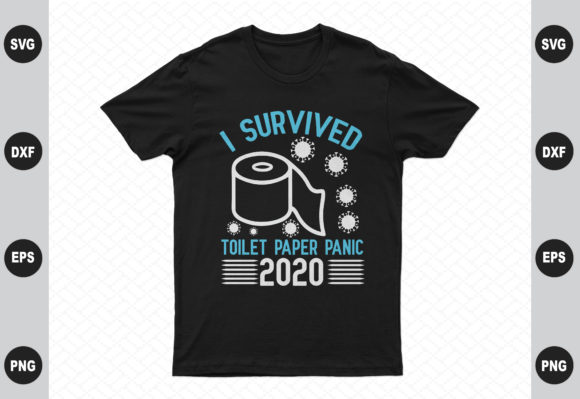
I Survived Toilet Paper Panic 2020
First Impressions: Humor with Heart—and a Few Design Realities
When I opened I Survived Toilet Paper Panic 2020 for the first time, I smiled—but not just because of the nostalgia. As an embroidery designer who’s stitched everything from nursery monograms to boutique sweatshirt collections, I immediately scanned it for what really matters in real-world use: legibility at stitch scale, balance between wit and wearability, and whether the visual rhythm holds up when translated into thread. It’s a compact, centered phrase with bold, slightly rounded sans-serif lettering—no extra flourishes, no clipart clutter. That simplicity is its biggest strength… and also where careful decisions begin.
A Real Project Test: Embroidering It on a Linen-Cotton Tote Bag
Last week, I prepped I Survived Toilet Paper Panic 2020 for a custom tote bag order—a small-batch run for a local café’s “Pandemic Recovery Pop-Up.” The fabric was medium-weight linen-cotton blend, lightly textured but stable. I used a standard 4” hoop and medium tear-away stabilizer. What stood out? The letter spacing held beautifully—no crowding, no awkward gaps between “I” and “Survived.” The “2020” sat cleanly on the baseline, avoiding the common trap of sinking or floating that trips up less-polished machine embroidery designs. But here’s the quiet truth: the font weight leans *just* shy of heavy—so on dark fabrics or dense weaves, you’ll want to bump thread contrast (think charcoal gray on navy, or white on black) and confirm your fill stitch density doesn’t ghost through.
Where It Shines—and Where It Needs Guardrails
I Survived Toilet Paper Panic 2020 works best where personality meets practicality:
- Sweatshirt embroidery: Its clean shape anchors nicely on chest placements—no distortion on ribbed cuffs or curved hems.
- Embroidered patch: At 3–4 inches wide, it scales well for iron-on or sew-on patches on jackets, backpacks, or baby denim overalls.
- Baby embroidery: On a onesie or burp cloth, it reads as sweetly ironic—not edgy, not overwhelming. Just right for gift sets.
- Holiday embroidery: Paired with a subtle snowflake or coffee mug icon (added manually), it fits perfectly into “2020 Survivors” stocking stuffers or New Year’s Eve party favors.
But tread thoughtfully with:
- Small hoop sizes (<4”): The full phrase shrinks fast. Consider cropping to “Survived 2020” if stitching on caps or toddler hats.
- Stretchy fabric: T-shirt knits need cut-away stabilizer underneath—this design’s even letter height helps, but loose tension will blur the “T” and “P” edges.
- Textured or napped surfaces: Fleece, terry cloth, or bouclé yarns can swallow fine interior details—test stitch density before committing to a full run.
- Dense stitch areas: There are no satin-stitch borders or layered applique elements here—so while that keeps production simple, it also means the design relies entirely on clean fill and running stitch execution. No forgiving “flourish buffer.”
Design Integrity Meets Customer Trust
As an Etsy seller and craft fair vendor, I’ve watched buyers scroll past clever slogans that look flat or pixelated in mockups—and stop cold for ones that feel *made*, not just downloaded. I Survived Toilet Paper Panic 2020 lands in that trusted zone: it’s recognizable at a glance, emotionally resonant without being kitschy, and visually balanced enough to sit beside other high-quality embroidery files in your digital shop or client portfolio. It doesn’t scream “viral meme”—it whispers “I remember, and I’m still here.” That quiet authenticity translates directly to perceived value in a handmade product or personalized gift.
Practical Notes Every Embroidery Designer Should Run Through
Before stitching I Survived Toilet Paper Panic 2020 into your next project, do these five things:
- Test on scrap fabric—especially if using textured, dark, or stretchy material. Note how the “O” and “0” hold shape; they’re the most vulnerable to distortion.
- Check thread color contrast in both natural and artificial light. A warm beige on oatmeal linen may read softly in person but disappear in photos.
- Review stitch density in your embroidery software. If it’s above 12,000 stitches, consider simplifying minor curves—or confirm your machine handles dense fills smoothly.
- Inspect corners and terminals: Are the ends of letters sharp or slightly rounded? This affects crispness on stiff fabrics like canvas or twill.
- Confirm licensing before selling finished items or bundling this as part of a commercial embroidery kit. Since it’s listed as a Graphics file for T-Shirt Designs, assume personal and small-batch commercial use unless stated otherwise—always verify.
Final Thought: Not Just a Phrase—A Moment, Stitched Right
I Survived Toilet Paper Panic 2020 isn’t about reliving stress—it’s about marking resilience with warmth and wit. As a machine embroidery design, it respects the craft: no unnecessary complexity, no visual noise, just clear intent and thoughtful spacing. Used intentionally—on a kitchen towel for a friend’s housewarming, a baby cap for a “born in the chaos” announcement, or a limited-run apron for a small-batch bakery—it becomes more than decoration. It becomes shared language, stitched in thread. And in this industry, that kind of resonance? That’s what turns a digital embroidery file into a lasting handmade product.