Garden Design, Free Weeds You Pick
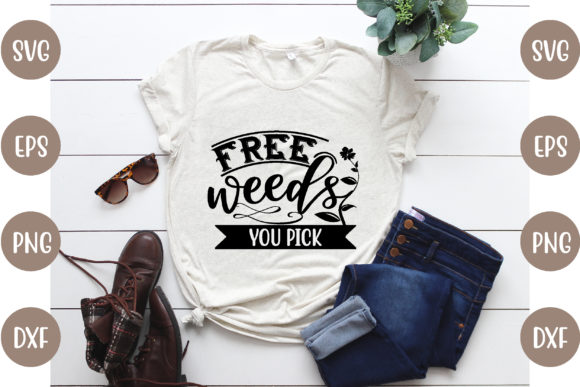
As someone who’s stitched hundreds of designs across apparel, home goods, and personalized gifts—everything from boutique baby onesies to Etsy bestsellers—I opened Garden Design, Free Weeds You Pick expecting charm with a wink. And it delivered: a loose, hand-drawn botanical sketch that feels like a garden journal page torn from a sunlit porch. No rigid symmetry, no over-polished vectors—just stems, leaves, and three or four whimsical “weeds” you’re invited to choose (or ignore). It’s not fussy. It’s not trying to be perfect. That’s exactly why it works.
First Impressions: A Design That Breathes
The layout is intentionally asymmetrical—tall stalks lean left, a curled vine arcs right, and one dandelion puff floats near the top edge. There’s generous negative space, which is rare in T-Shirt Designs meant for embroidery. That breathing room matters: it translates directly into stitch clarity on fabric. I immediately pictured it on a natural linen tote bag—unbleached, slightly slubby, with soft ecru thread. No dense fills, no tiny petals demanding 60-stitch-per-inch precision. Just clean satin stitch outlines, gentle fill stitch clusters for leaf bases, and a few strategic running stitches for texture. It’s an embroidery file that trusts your machine—and your judgment.
Where It Shines (and Where It Asks for Thought)
I tested Garden Design, Free Weeds You Pick across five real project types: a medium-weight cotton sweatshirt, a lightweight rayon-blend tee, a curved baseball cap front, a tea towel hem, and a baby-knit onesie. On the sweatshirt? Crisp, grounded, quietly confident. The design held its shape without puckering—even with minimal tear-away stabilizer underneath. On the tee? Slightly softer definition, but still legible at 4.5" wide. That’s where the design’s smart simplicity pays off: fewer fine details mean fewer places for thread to snag or shift on thin fabric.
The cap was the real test. Curved surfaces love bold, open shapes—and this design delivered. I resized it to 3.25" wide, kept the stem vertical, and avoided placing any delicate tips near the seam. Result? A subtle, organic accent that reads as intentional—not “stuck on.” On the tea towel? Perfect. The loose lines echoed the hand-embroidered look shoppers pay extra for in kitchen goods. And on the onesie? Gentle, non-overwhelming, and scaled beautifully without losing personality.
That said—Garden Design, Free Weeds You Pick isn’t magic on every surface. Avoid it on highly textured fabrics like bouclé or heavy terry cloth unless you’re willing to double-stabilize and reduce stitch density manually. It also doesn’t translate well to very small hoops (under 3")—those slender stems start to blur. And while the PNG version is handy for mockups, remember: for actual embroidery, you’ll need to digitize or confirm the included SVG/DXF/EPS files are properly converted for your machine. Always test on scrap fabric first—especially if stitching on dark fabric, where light-colored thread needs contrast checks.
What It Adds to Your Finished Product
This isn’t just decoration. It adds intentionality. When customers see Garden Design, Free Weeds You Pick on a handmade apron or a holiday gift pillow cover, they don’t read “generic floral.” They read “thoughtful,” “grounded,” “a little playful, a lot sincere.” That perception lifts perceived value—especially for craft business owners pricing items for Etsy or local boutiques. It also supports brand consistency: if your shop leans earthy, minimalist, or slow-made, this design reinforces that voice without shouting.
For personalized gifts? It’s quietly versatile. Swap out one “weed” for a client’s favorite herb, add a monogram beside the stem, or pair it with a simple phrase (“Grow Wild,” “Tend Gently”) in a complementary font. It doesn’t compete—it complements. And because it avoids cutesy tropes or seasonal clichés, it stays relevant year-round: spring baby showers, summer farmers’ market merch, fall harvest gifts, even winter wellness bundles.
Practical Notes Every Embroidery Designer Should Keep Handy
- Test before committing: Run it on scrap fabric matching your final project’s weight, stretch, and color—especially for baby embroidery or commercial embroidery where reliability is non-negotiable.
- Check thread color contrast: This design relies on line weight and spacing, not saturation. A pale mint on oatmeal linen reads differently than navy on white cotton.
- Review stitch density: If your digitized version feels too heavy for lightweight fabric, reduce fill stitch density by 10–15%—the design’s openness can handle it.
- Confirm hoop size early: At standard 4–5" width, it fits most mid-size hoops comfortably—but measure your cap frame or tiny patch hoop before digitizing.
- Inspect small details: Zoom in on the tip of that dandelion stem or the curl of the vine. Are they stitchable at your intended size? If not, simplify—not every sketch detail needs literal translation.
- Mock it both ways: Try black-and-white printable mockups on light and dark backgrounds. Does the balance hold? Does the “free weeds” concept still feel inviting—or get lost?
- Stabilizer matters: Use cutaway for knits, tear-away for stable wovens, and consider topping for napped fabrics like fleece. This design’s openness means stabilizer choice directly affects crispness.
- Licensing check: Since it’s sold as a digital embroidery file across formats (SVG, DXF, EPS, PNG), verify whether personal use only applies—or if commercial embroidery and resale of finished products are permitted. When in doubt, contact the creator.
Final Thought: A Quietly Confident Choice
Garden Design, Free Weeds You Pick won’t dominate a storefront banner or scream from a trade show booth. But it will earn repeat customers. It will make a new parent pause at a nursery decor listing. It will feel like a quiet nod between maker and buyer—“I chose this carefully. So did you.” For embroidery designers building trust through thoughtful execution—not flash—it’s a reliable, adaptable, human-scaled asset. Not every design needs to be a statement. Sometimes, the best ones simply grow where you plant them.